
Underwater Sculpture Park Expands
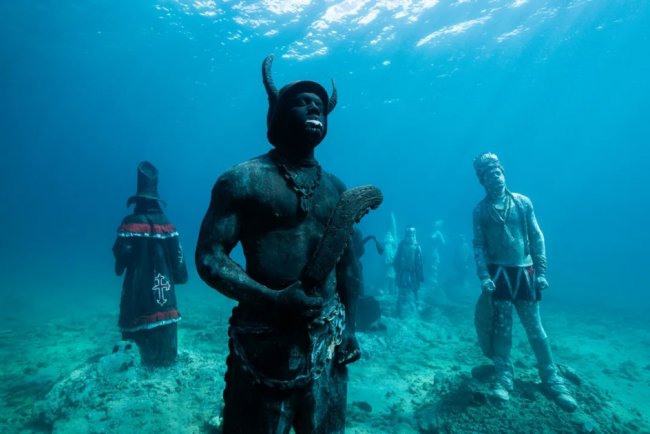
About 20 years ago, the world’s first underwater sculpture park, widely recognized and generating unprecedented interest, was opened off the coasts of Grenada. Now, artists have submerged 31 new sculptures into the blue waters of the Caribbean Sea, expanding this unique installation. Once installed, the sculptures were quickly “adopted” by marine life.
The Molinere Underwater Sculpture Park, created in 2006 and located in a protected marine zone off the west coast of Grenada, an island nation in northeastern Venezuela, originally covered 8,600 square feet of seafloor and consisted of 75 sculptures mainly created by British artist and ecologist Jason deCaires Taylor.
Taylor proposed the idea to assist in restoration after damage to Molinere Bay caused by Hurricane Ivan in 2004 and to raise awareness of climate change threats. His sculptures, made from sustainable, pH-neutral natural cement, provide habitats for coral polyps and other marine flora and fauna, functioning as artificial reefs.
This extraordinary park attracted diving enthusiasts and quickly gained popularity among visitors. The sculptures are located at depths of 5–25 meters in clear waters near the shore and can easily be viewed from glass-bottom boats.
This fall, deCaires Taylor presented the latest figures created in collaboration with Grenadian artists under the collective title “Coral Carnival,” commissioned by the Grenada Ministry of Culture and Tourism. The new additions, named “Spicemas,” are inspired by the annual carnival celebrations in Grenada.
According to Randall Dolland, CEO of the Grenada Tourism Authority: “The new works deepen our connection with the rich cultural heritage of our country.”
Four other sculptures by Grenadian artist Troy Louis were also installed, including one depicting an endangered hawksbill turtle.
For the first time, deCaires Taylor added color to the previously grey underwater sculptures. As reported by BBC, he used natural pigments with a calcium carbonate base, such as squid ink and turmeric, to give bold hues to the underwater figures. Some pieces are also adorned with gemstones and feathers.
Creating and transporting the sculptures was not an easy task. deCaires Taylor prepared them in his studio in Faversham, England, before shipping them to Grenada. Their placement took some time, leaving the sculptures suspended from a pier in Carriacou Bay for four weeks for the local yachts.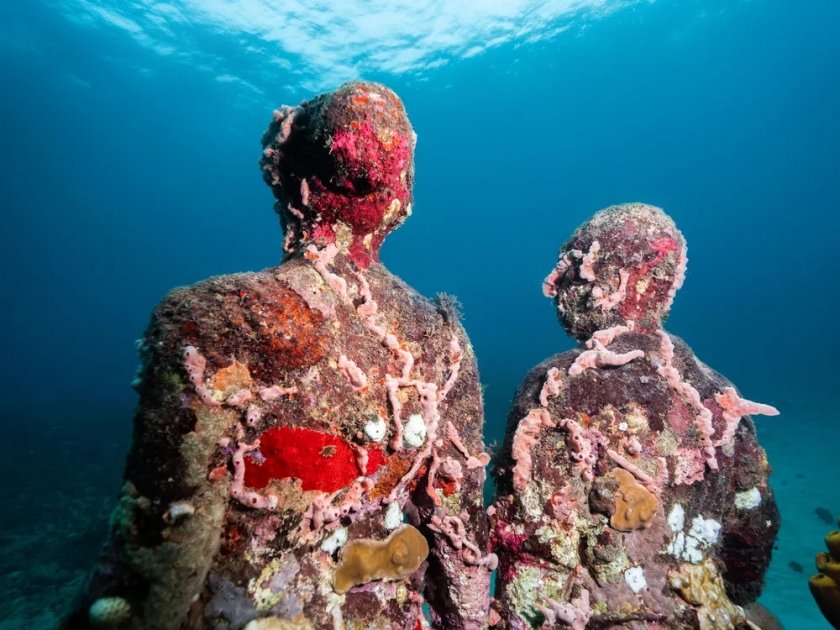
Finally, the crane lowered each piece into the water, where divers, including deCaires Taylor himself, carefully positioned them. Paul Nolz, a journalist from the Toronto Star, participated in the installation and was among the first to explore the new underwater expansion. He shared his impressions:
“The scenes unfold over open sandy areas and valleys along the bay, among natural rocks and coral, providing fascinating encounters with wildlife. I swam among reef squids in the colorful Caribbean Sea and observed various fish species and other ocean creatures.”
Among deCaires Taylor’s projects is the “Museo Subacuático de Arte” (MUSA), a monumental underwater museum located off the coast of Cancun, Mexico, founded in 2009, which now displays more than 500 sculptures. This project is considered one of the most unique tourism destinations in the world.